

We look at the reasons behind Playtech and Evolution’s stock price declines, despite both companies releasing excellent quality games today!
With nearly every iGaming market reporting growth in the number of bets placed on casino games and sports betting, it may come as a surprise to learn that most iGaming companies listed on the stock market are seeing share prices fall.
The Costs of Running a Large Gambling Company Are Increasing
Despite higher revenues coming from a rising number of gamblers, the costs associated with running an online gambling operation are increasing on a global scale.
I remember back in the day, eCOGRA’s seal of approval was the hallmark of a trustworthy online casino. However, since then, the United Kingdom has launched the UK Gambling Commission, Australia has banned online gambling and created licensing for sports book, and most countries in Europe now operate domestic licensing authorities.
Today, large gambling companies operating online casinos need to obtain multiple domestic licensing certificates. Italy, the UK, Denmark, Germany, Ontario (Canada), Holland, France, Spain, Portugal, Greece, and numerous other countries require operators to pay for licensing applications and renewals.
On top of this, Ireland and New Zealand will soon launch their domestic online casino gambling licences.
In all instances, once a gambling company has registered for licensing, there is a heavy tax commitment, with taxes being paid in multiple countries, and rightly so. However, with the current economic climate, governments are finding their fiscal coffers empty, so taxes are rising, which is ultimately eating into profits and hitting gambling share prices hard.
Casinobeats has an interesting report covering the biggest gainers and losers – Gaming Stocks Start 2026 on Somber Note, while we’ll be expanding on this with some iGaming stock overviews of our own.
Two Large Live Casino and Slot Software Providers See Drop in Stock Prices
Two key software providers that appear in nearly all our online casino reviews. Evolution and Playtech battle out in the live casino space. Also, both brands are also heavily invested in the online slot market. Playtech via its Playtech Origins and other studios such as Quickspin, Ash Gaming and Eyecon. For Evolution, its online slot market share is made up of software provider studios like NoLimit City, Red Tiger Gaming, NetEnt and Big Time Gaming, while Evolution also owns Livespins and Ezugi live dealer studios.
Playtech Sees Huge May 2025 Downside with No Recovery
Playtech has lost momentum with its share prices in 2025 mainly due to structural changes and investor repricing, not a sudden collapse in fundamentals. The sharp drop in May 2025 was largely mechanical: the stock went ex-dividend after Playtech paid a large special dividend following the sale of its Italian B2C arm, Snaitech. When that cash left the business, the share price adjusted downward accordingly.
However, sentiment was already weak. Investors were uneasy about Playtech’s post-sale profile, which left the company more concentrated on B2B revenues and fewer major partners. This raised concerns about earnings visibility and risk concentration. A credit rating downgrade around the same time reinforced those worries. On top of that, some profitability metrics softened in 2025, and heavy trading around the dividend suggested short-term investors were exiting positions.
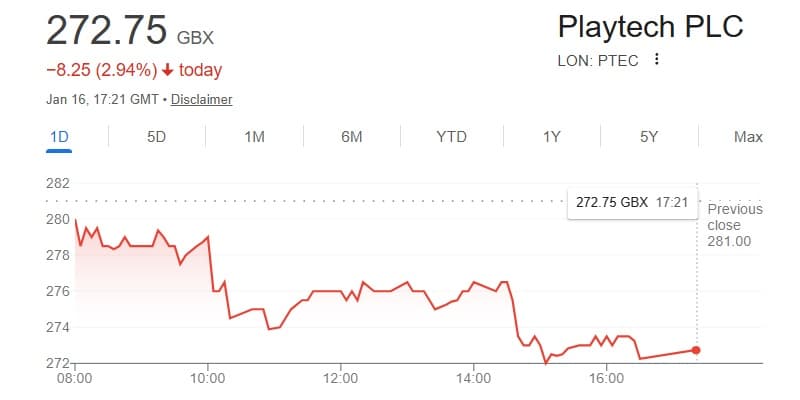
Image Courtesy of Google
In short, May’s drop was triggered by the dividend adjustment, but the loss of momentum reflected broader uncertainty about Playtech’s leaner, more concentrated business model going forward.
Evolution AB Live Casino & Online Slot Software Provider Losses Momentum
Evolution has always been in my portfolio. Since 2024, when I bought in for roughly 1,000 SEK. However, today’s price is around 40% down on my original market order. I have to say, it’s been what I like to call a topsy-turvy ride. I’ve seen the stock move to 1,370 SEK, where I took some profit; however, what remains is on a downward trend. For now, I am holding on to a glimmer of hope that the software provider will reverse course, which, based on technical data, suggests the stock is overbought on the RSI.
To look at the reason behind the dopr we have to go back to March 2024, where the slippery slope to 600 SEK began. Share price decline is mainly due to a shift in investor confidence, not a collapse in the business. The biggest drag has been regulatory and legal risk, after reports that Evolution’s games were available in restricted or unlicensed markets, raising concerns about fines, compliance costs, and future growth limits.
At the same time, revenue growth slowed, with some quarterly results missing expectations, particularly in Asia, which is a key region for the company. Ongoing Asia-related disruptions, analyst downgrades, and a broader valuation reset compounded the sell-off.
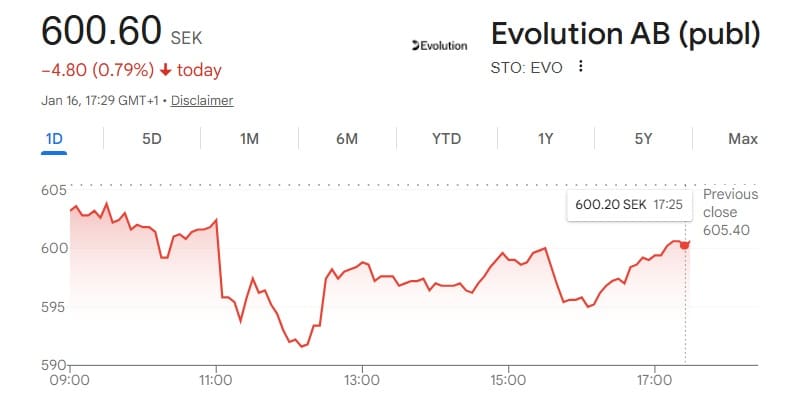
Image Courtesy of Google
In short, the Playtech stock fell as investors repriced risk and tempered growth expectations.
Will 2026 Be Any Different?
Honestly speaking, the way stocks work can be brutal. Over the years, I have invested in iGaming stocks, and it has always seemed like a no-brainer with stocks constantly growing and me taking profit while leaving my original investment in place. However, I don’t see 2026 bringing any miraculous rival to any of these stocks, and most experts would agree.
What’s more realistic is stabilisation and separation. The easy growth years are over. Regulation, taxation, and compliance costs are now permanent features of the industry, not temporary headwinds. Governments are done tolerating grey markets, and listed companies can’t quietly ignore that reality anymore.
That said, 2026 should be less chaotic than 2025. A lot of bad news has already been priced in: higher taxes, licensing costs, legal risk, and slower growth in Asia. For companies like Evolution and Playtech, the key change in 2026 isn’t explosive upside, and instead, it’s clarity. Investors will finally see what margins look like in a fully regulated, post-expansion world.
The winners won’t be the fastest growers, but the most disciplined operators: strong cash flow, diversified markets, realistic guidance. Weak balance sheets and over-exposed business models will continue to struggle.




























Leave A Comment