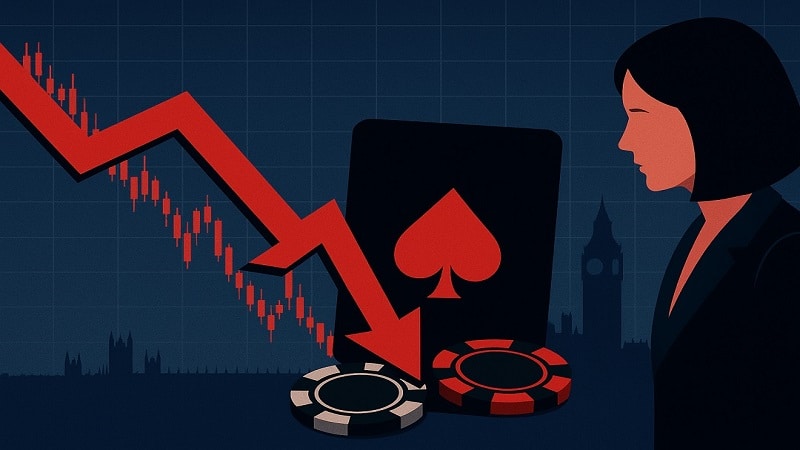
UK gambling stocks fall after tax hikes, but analysts see opportunities as stronger operators gain market share.
A week on, and the UK gambling market is still reeling from, although expected, one of its sharpest market jolts in years after Chancellor Rachel Reeves revealed hammering tax increases of up to 40% across remote gambling sectors in the Autumn Budget.
Panic, doom and chaos have since set in, with share prices tumbling and widespread job losses expected. Furthermore, with additional tax hikes on property, savings and dividend income that will give punters less money they can use playing casino games or enjoying online betting, the industry is under attack from both sides. Operators will have more costs as well as fewer customers willing to spend money on gambling.
Yet, despite the feeling of desperation across the UK, many leading analysts believe that now is the best time to start buying into major gambling operators. They’re of the opinion these tax hikes could ultimately strengthen the market, with smaller operators pushed out while the strong survive and prosper.
Online Casino and Sports Hit Hardest by Tax Increases
Estimated to boost UK coffers by £1.1 billion a year by 2029-30, the tax increases will prove brutal for many British online gambling operators, but none more so than those in the online casino gambling sector. Practically overnight on April 1, 2026, duty will essentially double from 21% to 40% for companies providing games of chance such as online slots and table games. Online sportsbooks are also bracing themselves, although they have a year longer to prepare, as duty on sports bets will increase from 15% to 15% on April 1 in 2027.
When announcing the changes at the Autumn Budget, Reeves claimed that online gaming had grown “too fast, too aggressively and with little regard for consumer harm”.
Operators Sound the Alarm as Shares Plummet
The effects of the announcement have already been felt, with market reaction immediate and widespread. Many UK-listed gambling stocks took a nosedive, with some of the most notable being:
- Evoke (888 and William Hill) – Share prices dropped a staggering 18% within days of the announced tax changes.
- Flutter (Paddy Power, Betfair, PokerStars and FanDuel) – CEO Kevin Harrington has predicted the increases will cost the business around £650 million over the next two years.
This has led to some already planning life away from the UK, highlighted by Flutter’s SkyBet set to move to Malta, while others have called the hikes counterproductive in the battle against unlicensed offshore sites and the dangers they bring to players and the industry. While major operators are squeezed from both sides, the black market, free of these taxes, will become more competitive overnight, leaving punters exposed to reduced safer gambling tools and initiatives.
Analysts Spot a ‘Silver Lining’
However, according to an analysis published by The Guardian, there could be a more positive outcome, at least for the bigger operators and the investors who hold with them and continue buying shares. Many major banks believe that the sharp sell-off we’re witnessing now could prove some fruitful medium-term buying opportunities, as the ‘industry’ herd thins with weaker operators leaving or being acquired, resulting in larger market shares for the strongest players.
According to an analysis published by The Guardian, several investment banks believe the sharp sell-off could create medium-term buying opportunities as stronger operators absorb the shocks faster than smaller rivals.
A Sector at a Turning Point
With tax increases likely passed on through reduced odds and lower payouts, the future outlook for UK punters is already looking grimmer than it has for some time (and that’s saying something). Yet, according to analysts, operators that survive this market consolidation or ‘clearing event’ are predicted to benefit in the long run. For investors, our question is whether you’re willing to weather the storm and potentially reap the rewards yourself.